• Home
  • Blog
  • About
    • Bio
    • Work Experience
    • Teaching
    • Workshops and Presentations
    • Publications
    • Media & Interviews
    • Professional Activities
    • Organizations
  • Workshops
  • Speaking
  • Writing
    • Articles
  • Books
  • Contact

Hinesight

For Foresight, Use Hinesight

You are here: Home / Archives for Andy Hines

Modern Values Bulldozing to the Future

June 17, 2013 by Andy Hines Leave a Comment

The full spectrum of values seemed to be in play in China in reading the Sunday New York Times. The eye-popping story was the announcement that the government is planning to move 250 million people into cities. The bulldozers are coming to clear the road for progress.

For some time now, the Chinese government has been attempting to expand growth beyond the immense and fast-growing coastal cities. I actually sat in on a pitch with a client in which government officials painted a rosy picture of how a then-barren inland area they were hoping my client would build a new plant on, would eventually become a boom town.

Apparently the carrott approach of enticing development outside the coast isn’t working fast enough, so out comes the stick – the bulldozers — on 250 million rural residents. It seems the thinking is that if businesses do not want to build in front of the market, well, then they’ll go ahead and bring the market first.

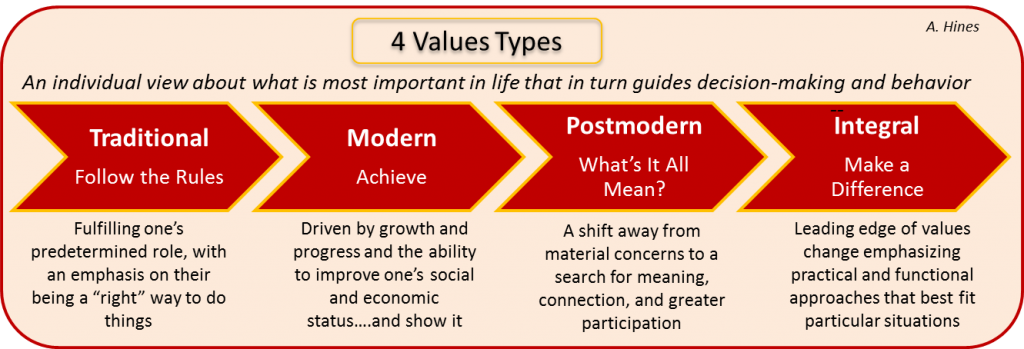
The values in play here are a mix. Certainly the dominant perspective is one of modern values, of achievement and growth with scan attention to the social consequences. Marketplace rules prevail here. But there is also a hint of the old traditional values, where authority reigns supreme. It is perhaps a bit surprising that something like moving a quarter of a billion people can simply be ordered by the government. [Imagine trying to move, say a dozen people, here in the US]

Lest we conclude that the values in play stop here. The very same day a story that China’s cabinet has adopted 10 measures to improve air quality in major cities. How postmodern of them! The pressure within the existing megacities is showing a postmodern influence, while the move of rural Chinese to cities shows a traditional influence, but all in all, we see a clear modern influence – growth as the key driver of the Chinese future. As we watch China’s development, we’ll look for clues as to when the postmodern pull begins to overcome the traditional push, recognizing that modernization still has a long way to go. Andy Hines

Filed Under: Foresight, Values Tagged With: China, future, modern, postmodern, traditional, values

The 4 izations: Inevitabilities or Predetermineds to 2020

June 10, 2013 by Andy Hines Leave a Comment

I suggested four “inevitabilities” to 2020 in a recent talk on higher education. Fans of the GBN scenario approach may recall the sorting of drivers into predetermineds and uncertainties – so “predetermineds” would be their parlance.  Key caveat is that this is for the affluent nations (W1 in my parlance). Granted, if they are inevitable, they are obvious, so be nice. Still, sometimes I think it’s useful to see what we are thinking about subjects that we all might think are, well, obvious. So….drawing from the talk, here is how I described the 4 izations:

  •  First, digitization is a key enabler of greater virtual collaboration; and what is happening over time, as younger people increasingly enter the workforce, is that virtual work is increasing a “first language” – they are completely comfortable with technology – we did a study for MTV of 12-24 year olds and their key source of stress with technology was that it might be unavailable; for us (older folks), where it’s a second language, we are not quite as comfortable.
  • Second, globalization of work means both more competitors as well as more markets; 24-7 teams are increasingly common, which disrupts traditional schedules – we take a conference call with Singapore at 9pm, but maybe we take a two-hour break for a workout or yoga during the traditional 8-5 timeframe. We will face competition from lower-cost competitors, suggesting a need to provide a value-add for our higher costs, but we will also be able to reach the booming emerging market economies more effectively.
  • Virtualization: virtual and real increasingly integrated (e.g., showrooming). Showrooming reverses the current approach where we research products online and buy in the store. Instead, we try out products in the store, and then buy them online. The store is designed as a place for customers to try before they buy.
  • Personalization: Long tail wags the dog. Work increasingly shifts outside the traditional office and as workers gain control over their space, they’ll want to personalize it. We move away from generic furniture and supplies designed for the huge office complex and have a myriad of different arrangements in varied workspaces, as they come in all sorts of sizes, shapes and locations.


What’s your list look like? Be interested to hear how readers would add/subtract to this list. Andy Hines

Filed Under: Foresight Tagged With: 2020, digitization, globalization, inevitabilities, personalization, predetermineds, virtualization

Panarchy, the Adaptive Cycle, and Change

June 3, 2013 by Andy Hines 3 Comments

I re-read Panarchy a while back and it’s even better the second time around! While I have pages of notes, thought I’d share three areas where it has influenced my practice.

  1. Revised our description of change. Fresh off teaching two week-long certificate courses, visions of change are dancing in my head. We introduce four aspects of change, dealing with sources, rates, levels, and time horizon. I think it’s time to add a fifth: cycles, drawing on the Adaptive Cycle notion at the heart of Panarchy. [I’m not quite sure if “cycles” is the right descriptor, it will have to do as a placeholder.]

Here’s the graphic of the adaptive cycle.

adaptive cycleThe 4 phases explained:

(R) Exploitation: rapid colonization of recently disturbed areas

(K) Conservation: sustained plateau or maximum population that is maintained

(Ώ) Release: creative destruction, e.g., in nature by fires, droughts, pests or intense pulses of grazing

(α) Reorganization: processes minimize nutrient loss so they become available for next exploitation

In business terms, exploitation is a period of growth and competition among entrepreneurs and survivors previous cycles; in conservation, the winners consolidate and then maintain the existing order; in release the established order breaks down and uncertainty increases; and in reorganization new players and alternatives emerge.

2. Rethink the analysis of “drivers.” Panarchy observes that ecosystems are comprised of fast and slow processes operating at different scales. Assuming that a domain or topic we are forecasting is an ecosystem, the “fast and slow at different scales” strikes me as particularly relevant to the phase in which we identify “drivers.” For practical purposes many times we simply consider drivers on equal terms. Yet, clearly they are part of systems moving at a different pace and having different reach or scope. There are fast-moving and slow-moving drivers with different scope. A challenge then, is how to operationalize these differences in “rate” and “scope?”

3. A new economic system should target adaptive capacity rather than steady state. A key notion of Panarchy is that adaptive cycles are nested in a hierarchy across time and space. Basically, there are many adaptive cycles, with different scopes and different time cycles, operating simultaneously. So, there are small-scale systems changing rapidly within large-scale systems changing slowly, multiply by “many” and note they are all interacting with one another at different levels, and you have a panarchy.

Fast-changing levels invent, experiment and test (learn) while the slower levels stabilize and conserve (continuity). So, the interaction between cycles in a panarchy combines learning with continuity. That clarifies the meaning of sustainable development: sustainability is the capacity to create, test, and maintain adaptive ability; development is the process of creating, testing, and maintaining opportunity.

I had been using the term “steady-state” to describe the goal of a transformed economic system, which I’ve been calling the Soft Path.  Well, not exactly. Panarchy points out that many efforts to “fix” natural systems shoot for a steady-state or equilibrium, but this misses the fact that the nature is continuously changing. The goal is not to achieve and maintain steady-state, but rather a system that is capable of adapting along with the continuously changing system. Thus, a transformative economic system is one capable of being adaptive.

These are just three insights that I was able to immediately apply. I have several more pages of notes to digest. Andy Hines

Filed Under: Foresight Tagged With: adaptive cycle, change, drivers, ecosystems, foresight, panarchy, soft path

An Insider’s Guide to Foresight Consulting at World Future Society

May 29, 2013 by Andy Hines Leave a Comment

I’m very pleased to offer the 2nd annual “Insider’s Guide To Foresight Consulting” day-long workshop at the World Future Society General Assembly on Thursday  July 18th in Chicago with my colleagues Riel Miller and Chris Carbone. This team should provide a real treat for audiences, as Riel and I did it ourselves last year and we’ve been fortunate to add Chris.

I, of course, have continued to split my time between teaching at the University of Houston’s Foresight Program and my consulting work via Hinesight. Riel is enjoying his position at the Director of Foresight at UNESCO after a long career as an independent consultant at Xperidox (among other things), and Chris oversees Innovaro, Inc.’s trend and foresight practice and manages its Global Lifestyles and Technology Foresight research projects. The different situations we come from and perspectives we bring should make for a rich experience for the audience. I really look forward to seeing this team in action.

We will cover similar ground as last year – from A to Z in foresight consulting — in which we blend together methods, tools, techniques, and case studies that range from basic diagnostic techniques to frameworks to subtle tips and insights learned from years of experience. And we’ll once again offer participants will have an opportunity to submit their own foresight projects for analysis by the instructor team. Hope you can join us! Andy

Filed Under: Education, Foresight Tagged With: consultant, consulting futurist, foresight, futurist, World Future Society

The Houston Futures Studies program is now “Foresight”

May 27, 2013 by Andy Hines 3 Comments

I am happy share that we’ve changed the name of the Futures Studies program to “Foresight.” Actually, the official name of the program at the main campus was “Futures Studies in Commerce.” Without going into details, we were not big fans of the “in commerce,” as it raised questions about whether we had changed the nature of the program when it moved from Clear Lake to the main campus back in 2007 (we didn’t).

The question of what to call the study of the future (and thus the program) has long been a matter of discussion within the field. As part of my dissertation research, I reviewed the field’s prominent journals on the topic. My review found evidence that the field is in the process of shifting how it refers to itself as “foresight,” but acknowledges we’re not all there yet. Nonetheless, as a program of futurists, we ought to be aligned with this change. Also, analysis of google trends revealed that “foresight” is an overwhelmingly greater used search term than futures studies or any of its variations. Since we are trying to raise our profile, it makes sense to make ourselves easier to find.

One issue we wrestled with was whether to add “strategic,” thus strategic foresight. There are many modifiers of foresight out there: technology foresight, adaptive foresight, etc., so we felt it was best to keep the name as all-encompassing as possible. Personally, I like that its one word and simple and recognizable: history is the study of the past and foresight the study of the future.

We believe the name change from “Futures Studies” to “Foresight” will aid the program in several ways:

  • Make it more likely that prospective students will find us on the Internet
  • Align with shifts among practitioners in the US and globally that refer to the field as foresight
  • Align with the professional association’s description of the field
  • Align with our own texts and how they refer to the field
  • Align with our success certificate program
  • Align with the emerging trend in how newer academic programs are referring to themselves.

We’re very pleased that the name change has been approved and this fall the new “FORE” rubric is being introduced for our course listings, and we’ll ne updating our materials. Andy Hines

Filed Under: Foresight Tagged With: foresight, Houston, houston foresight, houston futures, strategic foresight

Within you or Without You: The “System” and the Future of Higher Education

May 22, 2013 by Andy Hines Leave a Comment

I recently gave a talk on the future of higher education for “Technology Learning Conference” at the University of Houston-Downtown.

Much of the material came from a project with a foundation exploring the future of higher education to provide context for developing a strategy for achieving its vision of significantly increasing the percentage of adults earning degrees.

Archetype approach

We used the scenario archetype approach, which crafts scenarios using four archetypes or common patterns of change. (The system is the higher education system)

  • Continuation: The system moves forward along its current trajectory. This is the “official future” and usually considered most likely.
  • Collapse: The system falls apart under the weight of “negative” forces.
  • New equilibrium: The system reaches a balance among competing forces that is significantly different from the current balance.
  • Transformation: The system is discarded in favor of a new one with a new set of rules.

Continuation is possible, that is, between now and 2020 that present trends continue and there are no major surprises in higher education. Not sure I’d bet on that. In any case, that future has been researched to death. Dozens and dozen of reports on the future of higher education pretty much assume a continuation model. So, that one’s covered. Collapse is also possible. We’ll define collapse as graduation rates plummet and higher education is for the elite, like the old days. Yes, possible, but not so interesting to study. Best to look at it in terms of what to avoid.

Change from “Within” or “Without”?

So that leaves us with two interesting archetypes to explore: new equilibrium and transformation. New equilibrium is a scenario in which the higher education system is “challenged” and is able to successfully adapt. Transformation is one in which developments outside the system effectively transform higher education. It reminded me of the old Beatles song called “within you without you.” As someone working to change higher education, should you assume that the system can save itself and adapt to the challenges ahead? In this scenario, system is “shocked” and responds to save itself, most likely via a strong regulatory intervention that gets better results through focus, standardization, and mandates. Technology is important, but plays more of a supporting role than a lead. If you believe this scenario, you work within the system.

Or do you believe that the system is too far gone and will be unable to meet the challenges ahead? In this scenario, the system is transformed by pressure from the outside as new competitors using advanced technology and instructional approaches provide students, business, and society provide a model for traditional institutions to adapt to. Technology is a key driver and leader of the innovation that transforms the system. If you believe this scenario, you work with the players on the fringe that innovating and likely to lead the transformation of the systems.

Or, of course, pursuing a hybrid approach of working both within and without. It is unusual in my experience for there to be such a clear choice ahead. These two archetypes really capture the essence of the strategic choices ahead for those concerned about the future of higher education. You are at the fork in the road – take it! Andy Hines


Filed Under: Education, Foresight Tagged With: archetypes, future, higher education, scenario planning

Foresight success?

May 13, 2013 by Andy Hines Leave a Comment

I did a five-minute “Little Big” at the APF “Play” Gathering on May 3rd in Orlando. I called it “A Framework for Discussing Success.” The ideas emerged from dissertation and I am planning to write a journal article on it, but for now here are the main ideas.

I reviewed the foresight literature to see what futurists have said about success. What I found was that the discussion of success included a mix of purposes, goals, and benefits along with ideas about success. I identified forty sources that touched on these themes in a significant way. One common theme was that foresight work is ultimately aimed at decision-making, specifically making “better” or more informed decisions about the future. As the figure shows, the decision-making process can be broken down into three components: learning, deciding, and acting. Learning is about providing information about the future that can inform decisions. Deciding is the making of a decision. Acting is taking action on the decision, because without action, it’s not really a decision, unless the decision was to take no action.

outcomes framework finalThe aspects of success mentioned in the literature sorted nicely into these three categories (not show here for space reasons). What is shown is that the “backbone” of foresight work, that is, the six key activities of framing, scanning, forecasting, visioning, planning, and acting, feed into these three components of decision-making. Framing, scanning, and forecasting feed into learning; visioning and planning feed into deciding, and acting, of course, feeds into acting.

One way to interpret this framework is that most foresight work is aimed at learning, with a secondary focus on deciding, and a tertiary focus on acting. Put another way, most of our work goes into providing decision-makers with better information about the future to inform their decisions; sometimes they ask us to help with deciding (visioning and planning), and occasionally we help with acting.

My goal in developing this framework was two-fold: to see if we futurists can agree on a common framework for what successful work aims to achieve, and also to share with clients to set their expectations. If we can achieve that, we can then set about the logical follow-on task of exploring how to measure that success. Andy Hines

Filed Under: Foresight Tagged With: APF, foresight, futurist, outcomes, professional futurist, success

16 things that made me go hmmm at APF’s “Play”

May 7, 2013 by Andy Hines 1 Comment

Thought I’d share some musings from my experience at the APF “Play” gathering. Borrowing from the old C&C Factory song, here are 16 Things That Made Me Go Hmmm.(I’m not attributing as I don’t want to misquote anyone or get them in trouble)

  1. LVC for types of simulation: Live players – football practice; Virtual – people in virtual; Constructive – virtual in virtual
  2. Models –> simulations –> forecasts
  3. Difference between play and games: Play is about exploration, without winners and losers; Games are based on a model and have  winners and losers
  4. Two outcomes for training simulations: (1) Learning about the situation, e.g., how to fight fires (2) Learning about oneself, e.g., how did I behave in the situation?
  5. “We don’t care about succeeding…we sometimes fantastically fail…learn….and keep learning”
  6. It occurred to me (andy) that personas are going to move from posters to simulations
  7. I’ve been trying to think of what to call the six activities of foresight we teach: framing, scanning, forecasting, visioning, planning, action; I saw some word art on a wall that looked like a spine, but that didn’t seem right, but “backbone” did. Wonder if it will stick? Ideas seem to emerge when you’re in a relaxed environment, with good people, and enjoying yourself.
  8. Evolution of big data from descriptive to predictive to prescriptive
  9. “Smart cities” of the future may not be connected by geography, but rather by the smart ICT platform
  10. It was touching to see “the Godfather” appropriately recognized (nice job, Lee!)
  11. “Research makes zombie games really useful.”
  12. App culture has decimated the game studios, and very few app makers make any money
  13. There is a dark side to gamification – e.g., social games are really about getting your money more than about encouraging social good
  14. On my summer “to do” list: developing more games in our curriculum
  15. APF has done amazingly well in consistently making the gatherings an ideal blend of learning, networking, and fun.
  16. Futurists are really fun people, perhaps a bit crazy, but good crazy! Andy Hines
Filed Under: Foresight Tagged With: APF, foresight, future, games, gaming, Play, professional futurist, simulation

Reflections on the Future of Cities

April 29, 2013 by Andy Hines 1 Comment

The Houston Futures extended family gathered for a weekend of futures fun on April 12 and 13. While a key purpose is to give students, prospective students, alums, faculty and friends a chance to socialize and network in person, there was also plenty of good discussion about the future. The topic theme on “city making” was curated by alum and Adjunct Faculty Dr. Cindy Frewen. Since Cindy and Dr. Bishop are putting on a summer course on Design Futures and design is an integral feature of city-making.

A great part of these events is getting to see familiar faces who we don’t get to see often enough. Professor Emeritus Oliver Markley kicked off the Saturday conference with a stellar presentation on “Alternative Images for Cities of the Future.” Among the points particularly catching my attention was a video (shareable future of cities) he showed from Alex Steffen of Worldchanging.com that raised the provocative notion that perhaps trying to making “clean energy” vehicles is a misdirected approach to clean, livable cities. Rather, he suggests, get rid of the vehicles altogether. He proceeded to demonstrated how make cities, or areas within cities, denser could effectively eliminate the need for vehicles. If everything is within walking distance, why drive? Brilliant!

Oliver was followed by new friend Todd Gentzel, Chief Strategist at Yaffe Deutser in Houston, who gave a brilliant presentation “Psychology and the Field of the Future.” Among his striking points was the introduction of Philip Zimbardo’s work on the psychology of time. Todd shared his framework of six time perspectives:

  • · PAST NEGATIVE (fixated on a difficult past)
  • · PAST POSITIVE (nostalgic for the good old days)
  • · PRESENT FATALISM (resigned to the forces of fate)
  • · PRESENT HEDONISM (living in and for the moment)
  • · FUTURE (planning for a better tomorrow)
  • · FUTURE TRANSCENDENTAL (anticipating the beyond)

Wonderful, such a handy framework in working with clients or audiences. Definitely something we need to work into our curriculum.

Rives Taylor, Director of Sustainable Design at Gensler, who is going to help out with the Design Futures course this summer, presented “Lessons from Houston: Infrastructure of a Resilient City.” I had to suppress a squeal of delight when Rives presented a slide on Integral Thinking for “Resilience Planning.” The use of the integral 2×2 also had my Alternative Perspectives students in the audience smiling as this was a topic we devoted significant class time to. It’s great to see the spread of sophisticated futures thinking spreading.

Finally, Cindy presented “Great Urban Divides” that addressed the issue of how can cities accommodate the influx of population coming in the emerging markets – with their growing levels of affluence threatening to put a great strain on urban capabilities. My greatest takeaway the sharp drops in population forecast for China and India beginning mid-century. Sure, my mental modeling surmised they would level off, but seeing the graph with the decline was somewhat jarring. Reminds us of the important of taking the long view, which, um, yeah, we’re supposed to be doing!

There was more, but those were some high-level personal highlights for me. Of course, putting a bunch of futurists and friends together for a day, I would expect nothing less. Andy Hines.

Filed Under: Education, Foresight Tagged With: alex steffen, cindy frewen, cities, foresight, future, houston futures, Oliver Markley, rives taylor, todd gentzel, urban

Futurist: specialist or generalist?

April 22, 2013 by Andy Hines 2 Comments

A prospective student raised a question about specialization in foresight in a recent APF listserve conversation. This question is also a frequent one of our Houston Futures grad students. We discussed the question recently in Pro Seminar and did a  ”personal branding” exercise to help us think through how we want to present ourselves to the marketplace in doing our foresight work (see “The Personal Brand in Futures“ for additional thoughts) .

There is no “right” answer, of course. It depends on the individual and their circumstances and capabilities. First, to clarify terms. Generalist refers to one who works on a wide range of foresight topic and use a range of tools. I would put myself in that category, having seemingly worked on the future of almost everything over the last 20+ years. Specialist refers to one who picks a particular domain or topical interest, and becomes an expert in it, along the lines of an “energy futurist,” “transportation futurist,” “legal futurist,” etc. It may also be possible to be a “single method” futurist and brand your expertise in say, doing a particular type of scenario technique, or perhaps being expert simulations and gaming. I haven’t seen much of this, but is seems plausible. For instance, when I think of CLA (causal layered analysis), I think of Sohail.

And, of course, there are hybrid versions. Mostly generalist with some specialization. In my case, for instance, I’ve done so much work on consumer insight and values that I know present that as a specialization. I suspect, over time, that many generalists find this happening. Or you start as a specialist and gradually expand into new areas.

For students, though, is there a better way? One clue might be whether the student already has a subject matter expertise and can then futurize it. It may be that an undergrad major or work experience provides the foundation for specialization. It is probably a bit easier to break into professional foresight with a specialization, as it addresses the credibility question. It’s perhaps tougher to break in as a generalist, unless you are willing to pay your dues and start at the bottom. These are the days of entry-level research assistant that I remember, hmm, somewhat fondly.

It also helpful to take stock of what makes you happy. Would you be okay being narrowly focused, perhaps going over the same ground, giving the same talk, again and again? Or do you live for the challenge of always breaking new ground – and being okay with the risk that you’re going to miss something obvious in an area new to you (every generalist’s nightmare)?

It depends, but knowing yourself and your anticipated brand can help you point you in the desired direction, and, of course, we can always change. Andy Hines

Filed Under: Education, Foresight Tagged With: APF, foresight, futurist, generalist, houston futures, professional futurist, specialist
«Older Posts

APF Association of Professional Futurists BeInkandescent change Consumershift consumer understanding consumption education energy enoughness forecast forecasting foresight future Futures Studies futurist futurists global happiness higher education Houston houston futures integral integral futures jobs modern needs need states organizational futurist postmodern professional futurist review scenario scenarios society soft path spiral dynamics strategic foresight technology thinking about the future traditional values work World Future Society world values survey Books (15)
Education (19)
Forecasting (23)
Foresight (89)
Future Hype (4)
Media (15)
Science & Technology (9)
Talks (27)
Uncategorized (1)
Values (124)
Work (19)

WP Cumulus Flash tag cloud by Roy Tanck requires Flash Player 9 or better.

RSS Hinesight

  • Modern Values Bulldozing to the Future June 17, 2013
    The full spectrum of values seemed to be in play in China in reading the Sunday New York Times. The eye-popping story was the announcement that the government is planning to move 250 million people into cities. The bulldozers are coming to clear the road for progress. For some time now, the Chinese government has […]
    Andy Hines
  • The 4 izations: Inevitabilities or Predetermineds to 2020 June 10, 2013
    I suggested four “inevitabilities” to 2020 in a recent talk on higher education. Fans of the GBN scenario approach may recall the sorting of drivers into predetermineds and uncertainties – so “predetermineds” would be their parlance.  Key caveat is that this is for the affluent nations (W1 in my parlance). Granted, if they are inevitable, […]
    Andy Hines
  • Panarchy, the Adaptive Cycle, and Change June 3, 2013
    I re-read Panarchy a while back and it’s even better the second time around! While I have pages of notes, thought I’d share three areas where it has influenced my practice. Revised our description of change. Fresh off teaching two week-long certificate courses, visions of change are dancing in my head. We introduce four aspects of […]
    Andy Hines
  • An Insider’s Guide to Foresight Consulting at World Future Society May 29, 2013
    I’m very pleased to offer the 2nd annual “Insider’s Guide To Foresight Consulting” day-long workshop at the World Future Society General Assembly on Thursday  July 18th in Chicago with my colleagues Riel Miller and Chris Carbone. This team should provide a real treat for audiences, as Riel and I did it ourselves last year and we’ve […]
    Andy Hines
  • The Houston Futures Studies program is now “Foresight” May 27, 2013
    I am happy share that we’ve changed the name of the Futures Studies program to “Foresight.” Actually, the official name of the program at the main campus was “Futures Studies in Commerce.” Without going into details, we were not big fans of the “in commerce,” as it raised questions about whether we had changed the […]
    Andy Hines
  • Within you or Without You: The “System” and the Future of Higher Education May 22, 2013
    I recently gave a talk on the future of higher education for “Technology Learning Conference” at the University of Houston-Downtown. Much of the material came from a project with a foundation exploring the future of higher education to provide context for developing a strategy for achieving its vision of significantly increasing the percentage of adults [... […]
    Andy Hines
  • Foresight success? May 13, 2013
    I did a five-minute “Little Big” at the APF “Play” Gathering on May 3rd in Orlando. I called it “A Framework for Discussing Success.” The ideas emerged from dissertation and I am planning to write a journal article on it, but for now here are the main ideas. I reviewed the foresight literature to see […]
    Andy Hines
  • 16 things that made me go hmmm at APF’s “Play” May 7, 2013
    Thought I’d share some musings from my experience at the APF “Play” gathering. Borrowing from the old C&C Factory song, here are 16 Things That Made Me Go Hmmm.(I’m not attributing as I don’t want to misquote anyone or get them in trouble) LVC for types of simulation: Live players – football practice; Virtual – people […]
    Andy Hines
  • Reflections on the Future of Cities April 29, 2013
    The Houston Futures extended family gathered for a weekend of futures fun on April 12 and 13. While a key purpose is to give students, prospective students, alums, faculty and friends a chance to socialize and network in person, there was also plenty of good discussion about the future. The topic theme on “city making” […]
    Andy Hines
  • Futurist: specialist or generalist? April 22, 2013
    A prospective student raised a question about specialization in foresight in a recent APF listserve conversation. This question is also a frequent one of our Houston Futures grad students. We discussed the question recently in Pro Seminar and did a  ”personal branding” exercise to help us think through how we want to present ourselves to […]
    Andy Hines

Categories

  • Books
  • Education
  • Forecasting
  • Foresight
  • Future Hype
  • Media
  • Science & Technology
  • Talks
  • Uncategorized
  • Values
  • Work

Return to top of page

Copyright © 2013 ·Delicious Theme on Genesis Framework · WordPress · Log in