 by

Perhaps the Blue Tsunami has made it safer to talk about squishy concepts like “The Love Economy?” The concept from the late futurist Hazel Henderson in my view was a crowning achievement of hers … in a life full of crowning achievements.
The challenge that Hazel’s work attacked was “the delusions of money-measured GDP growth and all the price-denominated, over-aggregated macroeconomic statistics that dominate our lives and limit our choices … showing how this conceptual apparatus incentivizes individual self-interest, greed, bad behavior, even the Seven Deadly Sins!” [Note: I recently touched on the sin aspect: Capitalism, Stagnation and the Pursuit of Sin.]
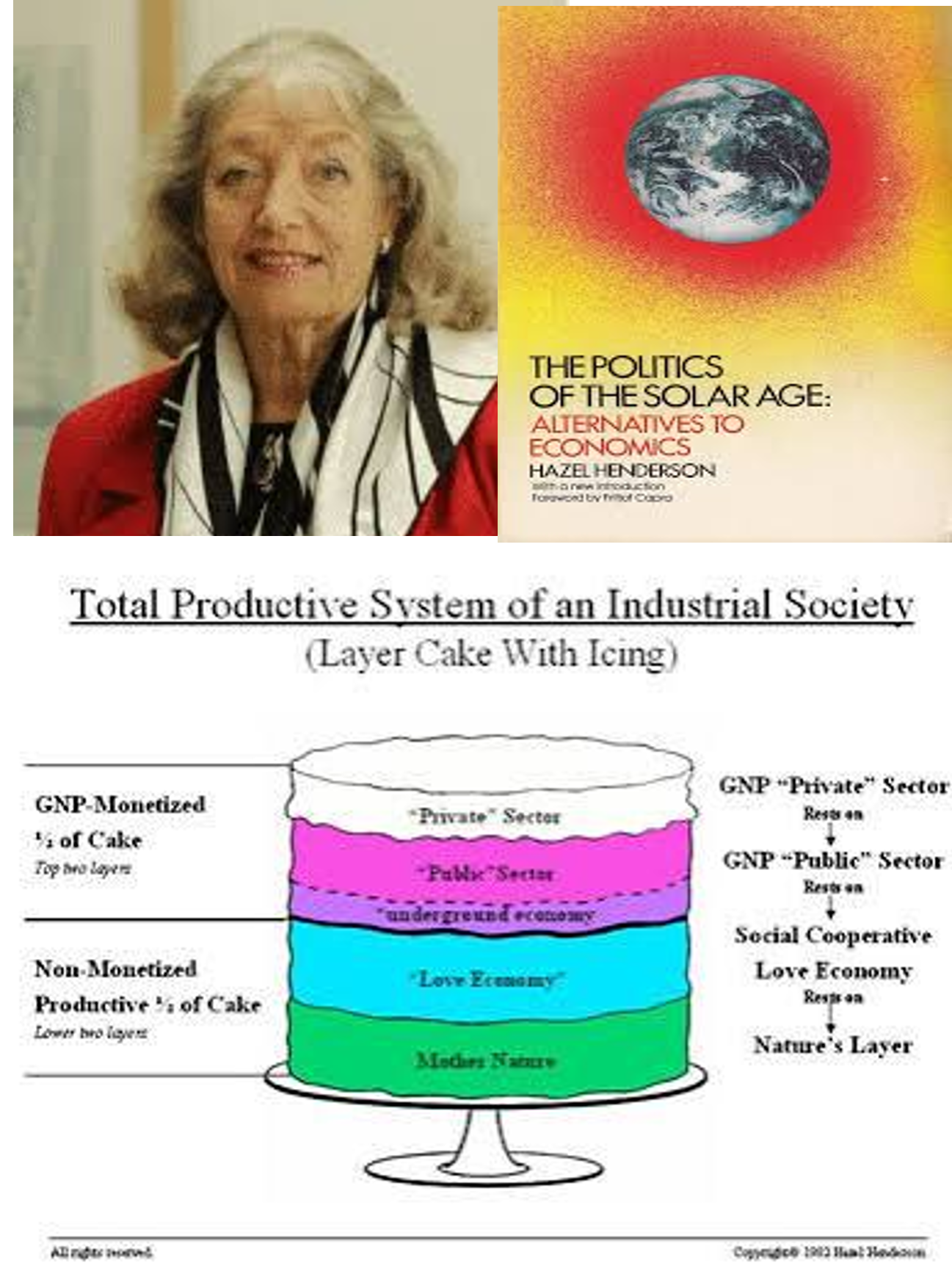
She was long critical of economics, citing how unpaid work was viewed as “uneconomic;” volunteering was deemed “irrational;” and human nature was assumed to be self-interested individualistic, competitive and even genetically determined! [Note: I touched on this: Wiring or Choice?]
A key contribution of her work was the idea of the layer cake, with the Love Economy as a fundamental layer. The metaphor says that traditional metrics like GDP only measure the top “icing” while ignoring the non-monetized foundations that keep the economy running, including the unpaid Love Economy and Mother Nature as the supporting base.
A critical point — that we don’t hear enough about – from her work is the overwhelming evidence that people find joy and satisfaction in giving and helping others and their communities. Today, we hear about loneliness, alienation, and lack of purpose. The practical necessity of pursuing money over-rides “non-productive” unpaid helping work … and we wonder why we’re unhappy! In short, end-stage capitalism has created systemic incentives to reward behavior that goes against our individual and collective self-interest. It takes a lot of effort to resist and, understandably, it is easier to just go along.
The ideas of associated with the Love Economy fit with the Gift Economy ideas of Imagining After Capitalism. In both cases, the easy criticism is they are naïve, impractical or utopic. Sure, true in the current system and context. But that’s the point of the After Capitalism work. Let’s design a different system and concept where love and caring and the joy it produces are what is incentivized.
I would like to note that a great challenge in Imagining After Capitalism was trying to include all the wonderful ideas. With a little more time on my hands I hope to be able to not only build the path forward to After Capitalism, but also look at the path of how we got here, as this is valuable intelligence to the path forward. For instance, why did such a wonderful concept at the Love Economy – and many others – not get the attention it and they deserved? What was missing? What does the teach us as we try to lay the path forward? – Andy Hines

Leave a Reply