 by
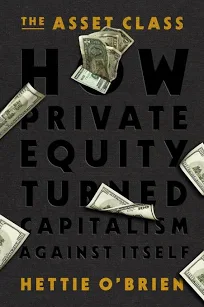
Not too far into Hettie O’Brien’s The Asset Class: How Private Equity Turned Capitalism Against Itself, it occurred to me that I was reading a familiar story. The financial sector found a new scheme to take other people’s money and put it into their pockets. The schemes are technically legal, but morally repugnant. I remember back in the 1990s when I was working for futurist Joe Coates when derivatives took off. We got a project that looked at the future of derivatives and our lead recommendation was “pray.” Anyone who remembers Joe knows that he was a tough customer not given to fancy, but when we looked at what was going on, it was very clear that disaster was ahead.
I have been following Ed Zitron’s amazing Where’s Your Ed At newsletter that has been tracking the AI bubble in detail (including a recent post on Venture Capital Is Killing Itself). As part of his analysis of what’s going on with the AI sector, he ventures into the larger context of venture capital, business, and the economy. His interpretation of AI, venture capital, business and the economy is basically: it’s all rotten … okay, mostly rotten. It’s a classic systems problem of everything connected to everything else and the rot in one place spreading throughout the system. The rot basically is greed. To be clear, a key point is that all schemes and bubbles are not the same, but greed is the common denominator.
Most of my After Capitalism research has centered on potential guiding images of the future, I have had to understand the basics of capitalism. I have identified more than 100 varieties of capitalism. It brings to mind the classic line from the Who song “Meet the New Boss, Same as the Old Boss. The same wolf in new sheep’s clothing!
My summary of what learned from reading The Asset Class: it reinforces the notion of a cycle in which the financial sector stretches, evades, or outright breaks the rules, crashes the system, and mostly hurts other people rather than themselves. There is a brief, weak attempt at reform, any lessons are eventually forgotten, and the stretching, evading and breaking resumes in a new form. The book gives some useful examples of the private equity version of the cycle. If history holds, private equity will fizzle out, there will be a hue and cry about how bad it was, and several years down the road a new scheme will take hold.
I suppose I bought the book to learn something new about private equity. Sure, there are some novel aspects about how it operates, but it’s the same wolf in different sheep’s clothing. The bigger lesson for us regarding After Capitalism is confronting the brutal facts of just how resilient these wolves are. They are powerful … support at the pinnacles of power. They are smart. They are savage. It makes them a very, very difficult foe.
Of course, we cannot simply lapse passively into cynicism. How can we combat the next greed-driven scheme? To be brutally honest, the power, scale, and resources of the schemers is daunting, and typically overwhelm any efforts to deter it. Head-to-head is a losing battle. What can we do differently? I’ve got some homework to do. – Andy Hines

Leave a Reply