 by
by It is hard to talk about alternatives to capitalism without hints of socialism or communism. You could argue that economic systems are organized based on individuals (capitalism), collectives (communism) or hybrid (socialism).
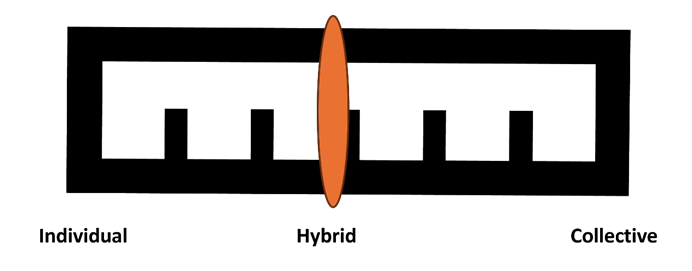
In exploring After Capitalism, we are going to be using the word “commons” a lot more. That does not make us “commies.” There are basically three ways to organize a society, individually, collectively (“in common”), or a hybrid of the two. Capitalism is an example of an individually-driven. Communism is example of collectively-driven, and socialism is an example of hybrid. It might be helpful to think of it on a continuum, as depicted in the figure. Various ideas will appear at various points on the continuum.
Any new system toward the collective end of the continuum is going to involve a collective or “commons” approach … which sounds like communism. The three guiding images — Circular Commons, Non-Workers Paradise, and Tech-Led Abundance — all rely to some degree on commons approach … for managing the resource commons, the social commons, and the tech or knowledge commons. So, we are going to have to get used to using the word commons and not be afraid of being called “commies” and patiently explain the difference between communism of the past and commons-based approaches of the future (and we’ll need a thick skin, as this explanation will not always work).
Personally, I have nothing against the original concept of communism, but it obviously turned out badly. Any “ism” can turn out badly, which doesn’t mean we must avoid any related concept forever. If there are only three main approaches, and one is a hybrid, we do not have much of a choice! Okay, so let’s put commies behind us and get to work on exploring commons-based approaches. — Andy Hines

Leave a Reply