 by
by 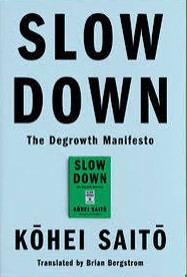
The best-selling Slow Down: The Degrowth Manifesto on degrowth from Kohoei Saito was published in 2020 (in Japan… 2024 in English)– – as was Jason Hickel’s best-seller on Degrowth. What? Two best-sellers on degrowth? Yes, it’s almost, but not quite, safe to talk about degrowth now … and we will definitely be talking more about it here.
Today, we tackle Saito. The radical-ness (if you will…) of this work makes its best-settling status truly amazing. He notes that the UN’s Sustainable Development Goals had become extremely popular in Japan at the time, but he felt that the interest was quite superficial. Nonetheless, he was surprised when the phrase “SDGs are the opiate of the masses” went viral on Japanese social networking sites. Perhaps this emboldened him to call for “degrowth communism.” His vision is “a more democratic, egalitarian, and sustainable vision of a new steady- state economy compatible with Marx’s vision of the future society.” I recently cautioned against using the term communism, and I stand by it … at the same time, I applaud Saito for his courage.
His boldness stems from the belief that human civilization is facing a threat to its very existence. SDGs don’t go far enough. Gestures like carrying a thermos so you don’t end up buying drinks in plastic bottles, or electric cars … are “meaningless in the end.” The point of no return is approaching; a point at which a series of rapid changes will occur that will make it impossible to ever return to how things were.
Like Hickel, he sees the power imbalance between North and South as no anomaly— it is, in fact, a result of the system of the North bleeding natural resources from the periphery (South) while at the same time shifting the costs of that growth onto them as well. He notes that Marx’s indeed saw capitalism displaces its contradictions “elsewhere” and thus rendering them invisible.
He goes on to say that the profit- seeking process has reached its physical limit. Capitalists strive toward unlimited increases in value, but the Earth is not unlimited. He observes that a key concept that has arisen in the recent reevaluation of Marx is the idea of “the commons.” He seeks to gradually expand the commons until, in the end, they displace capitalism entirely. This aligns with ideas in my review of Guy Standing’s excellent Plunder of the Commons.
The main difference between the form of degrowth proposed by Saito and other degrowth theorists is they generally avoided engaging with Marxism and workers’ movements. The “earlier degrowth theorists tended to focus on consumption instead, advising self- limitation to consumers.”
Again, I repeat my advice against advocating communism. I think Saito may be over-estimating the power of the left. He criticizes Srnicek and Williams’ concept of folk politics, but I have this concept at the heart of my Ineffective Left driver: “The far left continues to be ineffective in catalyzing change.” I suspect degrowth communism may not be effective in catalyzing change over the long term … but I sure do acknowledge and appreciate the work it has done in advancing the degrowth concept to this point! – Andy Hines

Leave a Reply