 by
by 
Mina McBride & Andy Hines, April 11, 2026
NOTE: I am reproducing the original LinkedIn post by Mina..
Why STILE?
In today’s rapidly evolving business landscape, organizations must not only anticipate change but also evaluate how close a proposed innovation is to becoming reality. This is where the STILE framework comes in—a strategic tool designed to assess the feasibility and readiness of emerging ideas across five critical dimensions called STILE Elements: Social Acceptance, Technological Capability, Infrastructure, Legal Clearance, and Entrepreneurial Zeal.
Originally developed by futurists at the University of Houston as part of Horizon Shift Analysis (HSA), a foresight methodology used to monitor domains under transition, STILE helps decision-makers move from scanning the horizon to activating change (it is helpful, but not necessary, to understand the Three Horizons framework by Bill Sharpe). This article provides a comprehensive guide to understanding and applying STILE for decision-makers or anyone charged with monitoring change within their field.
What Does It Mean to Monitor the Future?
Futurists engage in more than just scanning for signals of change; depending upon the nature and purpose of the specific project, they also monitor signals to track how closely current conditions align with their hypothesis about the change. Monitoring is a distinct and on-going process that revisits hypotheses developed during scanning or scenario development, allowing futurists to assess the directionality and accuracy of change over time. STILE supports monitoring by offering a framework to evaluate activation readiness. It helps teams move from passive observation to strategic action.
Why STILE Matters
STILE is more than an acronym—it’s a lens through which we can evaluate the maturity and viability of concepts, ideas, products, and services. Unlike forecasting tools that focus on trends or market potential, STILE emphasizes activation readiness. It answers the question: “How close is this future to becoming real?”
How close is this future to becoming real?
This is especially important in foresight work, where scanning identifies possibilities, but monitoring determines which futures are unfolding. STILE bridges that gap by offering a structured way to revisit hypotheses and assess whether conditions are aligning with expectations.
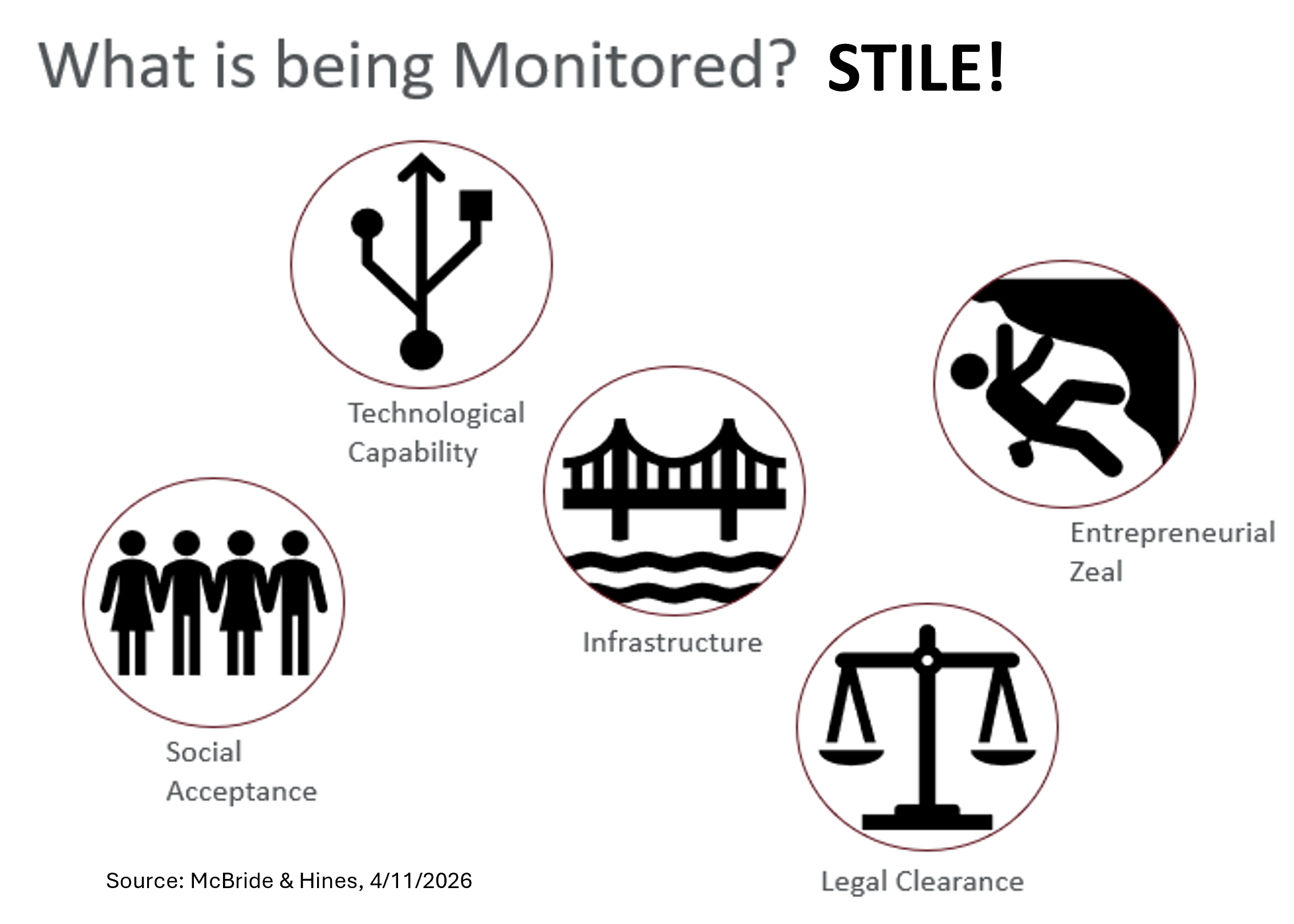
The STILE Elements
Social acceptance
This element evaluates whether the innovation is culturally and behaviorally acceptable to its intended audience. It asks:
- Do people want it?
- Is there demand or readiness?
Example: Standing-only airplane seats may be technically feasible, but if passengers find them uncomfortable or unsafe, social resistance could stall adoption.
Technological capability
Here, the focus is on whether the technology works—or can be made to work. It includes:
- Functionality
- Scalability
- Reliability
Example: Autonomous delivery robots may exist, but if they aren’t able to navigate crowded urban environments reliably, their deployment is limited.
Infrastructure
This element examines whether the systems, logistics, and physical or digital infrastructure are in place to support the innovation.
Example: A new bio-metric payment system may require widespread hardware upgrades across retail locations, which could delay rollout.
Legal clearance
Legal and regulatory considerations can be deal-breakers. Favorable policies need to be in place. This includes the existence of policies and laws that can be consistently applied.
Example: Although homeowners may want to build an accessory-dwelling unit or ADU in their backyard, if local zoning laws are non-existent, this may hinder progress.
Entrepreneurial zeal
Even if all other conditions are met, an innovation needs champions—individuals or teams willing to push it forward despite obstacles. These champions must possess both the will and resources to succeed.
Example: A sustainability initiative may be technically sound and legally viable, but without internal advocates willing to invest their will and resources, it may never gain traction.

How to Apply STILE
Step 1: Define what is being Monitored
Start by outlining the concept,innovation or initiative, clearly stating the initial hypothesis derived from the scanning or scenario work. What were the team’s expectations? Is the world evolving as anticipated? The hypothesis can be a broad statement like “We believe most people will cultivate their own food.” If there are specific indicators the team identified, such as “We think that in the future, at least 45% of adults in the United States will grow at least 25% of their own fruits and vegetables,” these can serve as a starting point as well.
Step 2: Rate Each STILE Element
Assess each element with a score on the spectrum of 1- 3 where 1=full adoption, 2=reservations or still in progress, and 3= non-existent or nearly non-existent. The numbers do not have to be exact as the intent is not to “predict” the future, but rather to gain an understanding of change in a domain. The closer the rating is to 1, the better.
Step 3: Identify Gaps
The research showed that for a change to take place, every element of STILE needed to be at or near 1, if even one element was missing, it would take more time for the change to evolve.
Step 4: Develop Action Plans
For each gap, outline steps to improve readiness. This might include pilot programs, stakeholder engagement, or infrastructure investment. (see the Key Ideas chart below)
Step 5: Monitor Over Time
STILE is not a one-time exercise. Revisit your ratings periodically to track progress and adjust strategies.
Real-World Example: EVs

Here’s an example of using STILE for Electric Vehicles (EVs) in the U.S. The United States is being used as an example due to the dynamic nature of the forces influencing adoption over the past decade.
Social Acceptance: Interest is growing but mixed— according to a 2025 survey by Pew Research, about 33% of U.S. adults say they are likely to consider an EV for their next purchase, while 53% remain unlikely. Concerns about cost, range anxiety, and charging access persist, though environmental benefits and fuel savings are strong motivators. One might give a rating of 2 for Social acceptance.
Technological Capability: Trade and industry press states that advanced battery technologies (including solid-state), ultra-fast charging, and vehicle-to-grid (V2G) systems are emerging. However, interoperability and battery degradation remain challenges. One might rate Technological capability a 1.5.
Infrastructure Support: There are currently over 192,000 public charging ports in the US and nearly 70,000+ station locations in the U.S., but reliability issues (78% uptime) have been reported by researchers and uneven geographic distribution create “charging deserts.” Most charging still occurs at home, and large-scale build out is needed to meet future demand. While there has been a lot of progress, infrastructure has a long way to go. One might rate this element as 2.8.
Legal Clearance: No major legal barriers exist; in fact, regulations and incentives strongly favor EV adoption. Federal and state programs provide tax credits, grants, and mandates like California’s Advanced Clean Cars II, which targets 100% zero-emission new car sales by 2035. However, recently, both the federal tax credits and zero-emission targets by key stakeholders have been rolled back. Where one may have given this element a 1 several months ago, it is now closer to 2.
Entrepreneurial Zeal: Recently, Entrepreneurial zeal has been extremely high. Startups and established automakers were investing billions in EV production, battery innovation, and charging solutions. New ventures range from charging infrastructure and battery recycling to EV-focused mobility services. Yet, with the changes on the policy front (Legal clearance), investments have changed and planned factories and projects are no longer being pursued. Where a year ago, one may have rated this a 1, this element is now closer to a 2.
Overall Assessment: The STILE analysis shows EV adoption is promising, with strong technological progress and entrepreneurial momentum, but infrastructure reliability, broader social acceptance, and favorable policies remain critical hurdles. In the example, our average rating was a 2 (which corresponds to the 2nd horizon, an area of transition or “the Battle Zone”) Moving an element closer to full H1 adoption can take several years or even a decade to do since doing so is the work of a system not any one individual or organization.
Tips for Success
Customize the Framework: STILE adapts to your industry or domain. For example, in HR, “Legal Clearance” might focus on a particular labor law, while in tech, it could involve watching the advancement of a specific policy.
Use Multiple Sources: When performing research for STILE analysis, include interviews, research articles, data from social listening, popular press, etc. to get a well-rounded view of the landscape. Be aware of bias that may be present in the sources and adjust for it by looking for views to the contrary.
Engage Stakeholders and Partners: Involve cross-functional teams to ensure diverse perspectives and leverage domain-specific knowledge. Having groups rate each STILE Element given the same data can help arrive at a consensus by highlighting areas where there is an unusually high variation in ratings.
Highlight areas where readiness is low: These are strategic focus points that can be used to determine where to apply influence or experiment filling a gap.
Document and Share: Create STILE reports or dashboards to communicate findings and track progress.
Conclusion
STILE is a powerful tool for navigating uncertainty and driving innovation. By evaluating Social acceptance, Technological capability, Infrastructure, Legal clearance, and Entrepreneurial zeal, teams can make informed decisions about which futures to pursue—and how to get there.
Whether you’re a foresight researcher, product manager, or strategic planner, STILE offers a practical, actionable framework to move from possibility to reality. — Mina McBride & Andy Hines

Leave a Reply