 by
by 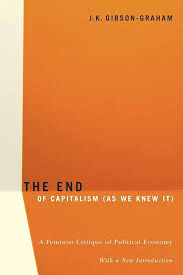
I found out about The End Of Capitalism from an interview by C. J. Polychroniou, Beyond Capitalism: The Diverse Economies, in which George DeMartino and Ilene Grabel talked about how the path-breaking work of JK Gibson-Graham (the pen name of Julie Graham and Kathy Gibson) fundamentally altered the how many scholars view the concept of “the economy.” A central principle of their work was that economies, such as the US, that we identify as “capitalist” are actually comprised of many different and non-capitalist arrangements. Interesting!
I was sufficiently intrigued to get the original book, which was written in 1996 with a new edition ten years later. As the authors reflected on what had happened over that ten year period, they observed that individuals and groups were pursuing research on a range of alternatives, from cooperatives to local currencies to community credit institutions to commons restoration. After Capitalism is not a new thing!
Though certainly no fault of the authors, it was a bit disappointing to note that the oft-used examples of the Zapatista movement and Mondragon were referred to … way back then. The disappointing aspect is that we are still using them today. It’s great that these types of activities have been doing on a long time… not-so-great that fresher examples are not replacing or supplementing them.
I’ll confess I was a bit nervous that I might have missed a potential guiding image, but that was not their purpose [perhaps in their follow-on work A Postcapitalist Politics?].
What I did find that made this a worthwhile read was a compelling case that the notion of capitalism as an overarching ubiquitous operating system over-states the case. I clearly stated capitalism is an operating system in my work, but I think it is a very fair and useful perspective to acknowledge that here are in fact many alternatives operating around or outside of it. The fact that the economic space is more open and less dominated is grounds for hope in their view. I agree! In their words: “Representing the diverse economy is a deconstructive process that displaces the binary hierarchies of market/non-market and capitalism/non-capitalism, turning singular generalities into multiple particularities, and yielding a radically heterogeneous economic landscape.” I included this quote to advise potential readers that that the prose is heavily academic :-).
By non-capitalist economy, they mean things like the personal investment managers who are self-employed entrepreneurs and leverage their own surplus labor, self-employed workers in general, and those involved in the production of household goods and services. They point out that many economic transactions are non-market transactions in which goods and services are not produced as commodities. Alas, since this book was written, capitalism has been on quest to commoditize everything possible … and has had great success in doing so.
They were hopeful for a post-capitalist future and saw signs of decentralized or community-based alternatives having the potential to be globally transformative.” But they also acknowledge a difficult path ahead: “Given present circumstances, we would be crazy to offer an optimistic prognosis for the world and its denizens, but we can learn to call forth hope from our world-battered sensibilities.” This 1996 quotes sounds too much like the present.
Nonetheless, we have an important conceptual insight. Capitalism is not as monolithic as represented and there is indeed room for change. Let the work continue! – Andy Hines

Sir,
1. A passive and semi-clumsy statement here: “…capitalism has been on quest to commoditize everything possible … and has had great success in doing so”.
“Capitalism” is a concept/innovation not an entity able to act. using passive language seemingly gives “capitalism” agency. it obfuscates the truth that if “commoditization of everything possible” is indeed the objective (which is questionable), the objective is due to humans acting according to human-nature.
if the cons of “capitalism” outweigh the pros, which you argue frequently, what needs to change is human-nature… or governing that imposes on human nature… good luck on changing human nature. god help us if you think the solution is more government imposition… please reread the federalist papers…
2. “They were hopeful for a post-capitalist future and saw signs of decentralized or community-based alternatives having the potential to be globally transformative.”
Capitalism (depending on how the user of the term defines it) has “decentralization” as one of its major strengths… What the heck do you and the authors mean by “capitalism”. It feels like we are talking about 2 different concepts…
“community-based” sounds like “marxism” in disguise… i’m all for voluntary re-distribution of wealth… i’m damn scared when people start talking about empowering government to redistribute wealth – again, please reread the federalist papers…
3. “But they also acknowledge a difficult path ahead: “Given present circumstances, we would be crazy to offer an optimistic prognosis for the world and its denizens, but we can learn to call forth hope from our world-battered sensibilities.”
“This 1996 quote sounds too much like the present.”
No, it sounds like people that over-index on negative data, events, conditions, and viewpoints (dnc, mainstream press, academics, and scientists that get their funding from the federal government). In fact, it sounds like semi-educated 20-somethings that believe the environment is destroyed and freedom is on the verge of failing.
4. “Nonetheless, we have an important conceptual insight. Capitalism is not as monolithic as represented and there is indeed room for change.”
What? an insight? hello. A huge advantage of “Capitalism” (we may never know how you define it, though you seem to lean toward the views of bernie sanders, marx, and castro) is its ability to adjust to social conditions, physical conditions, and innovation. It is far from “monolithic”, unlike alternative economic systems that are restrained by central planning and management.
Who thinks “capitalism” is “monolithic”?
Perhaps the issue relates to something i keep asking – what do you mean by “capitalism”.
falling back on what you write in “thinking about the future”, how do you “frame” the concept of “capitalism”?
To me, it seems like you have an angst against “capitalism”, ignore the pros, over-index on the cons, and use a passive language so that you can select the data that substantiates your angst…
Please tell me where I’m wrong? But first, please “frame” capitalism for us/me…
seriously. i started watching your work years ago because i knew several people that had you for instructor/professor. they were impressed. impress me…
i look at my comments and think, wow, i’m being a jerk.
but
i have asked you to tell us what you mean by “capitalism” and it seems you don’t want to do that.
your use of passive language allows you to be a provocateur of change, but it also allows you to be evasive. change for the sake of change is rarely desirable… change for the purpose of being destructive without a good reason (pros v cons) is foolish… change for the purpose of pursing an ideology (especially one not aligned with human nature) is typically autocratic…
i don’t just cast aspersions… i have pinpointed where i disagree, and have explained why i disagree. i was hoping that you could push back and tell me where i’m off target… alas