 by
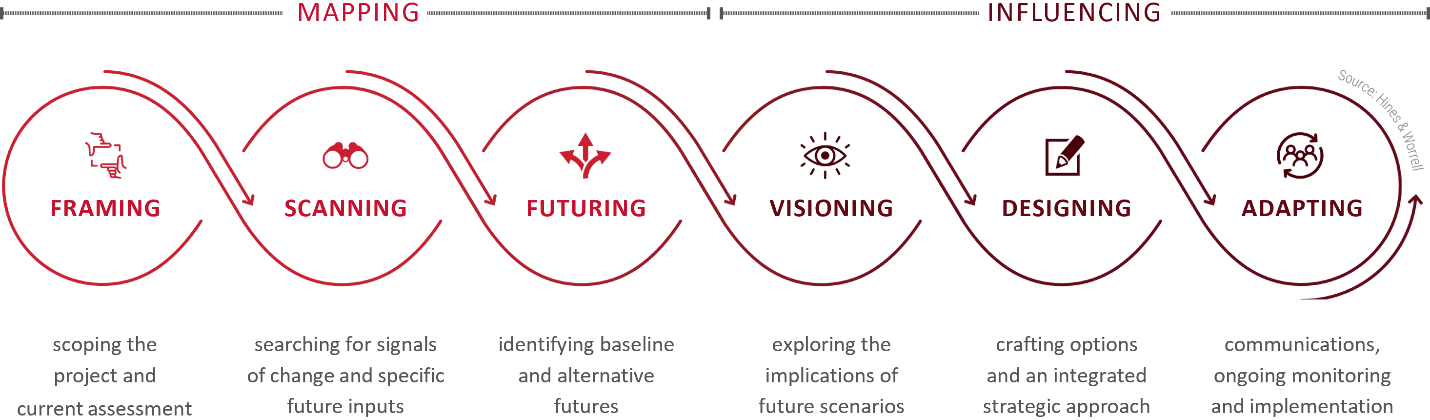
Okay methods geeks …. this one’s for you! I was asked to contribute a book chapter on the development of our six-step model for doing foresight work, known to the Houston Foresight family as Framework Foresight. It’s important to understand that we are part of a larger foresight ecosystem. Framework Foresight is the Houston version of how to carry out the six steps, but it is not the only way!
The book, Szenario-Management und Strategic Foresight is a terrific compilation of methods pieces from an excellent collection of practitioners. As the title suggests, some pieces are in German and some in English (Mine,thinking of course).
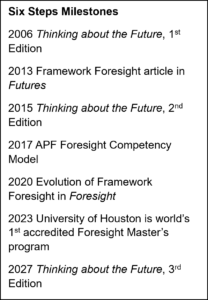
The article tells the story of how we developed the six steps of foresight, with the help of many, many colleagues from around the world, and how they have continued to evolve over time. They are at the core of the first edition of Thinking about the Future in 2006, were refined in the 2nd edition in 2015, and I’m busy working with colleague Adam Cowart on a 3rd edition.
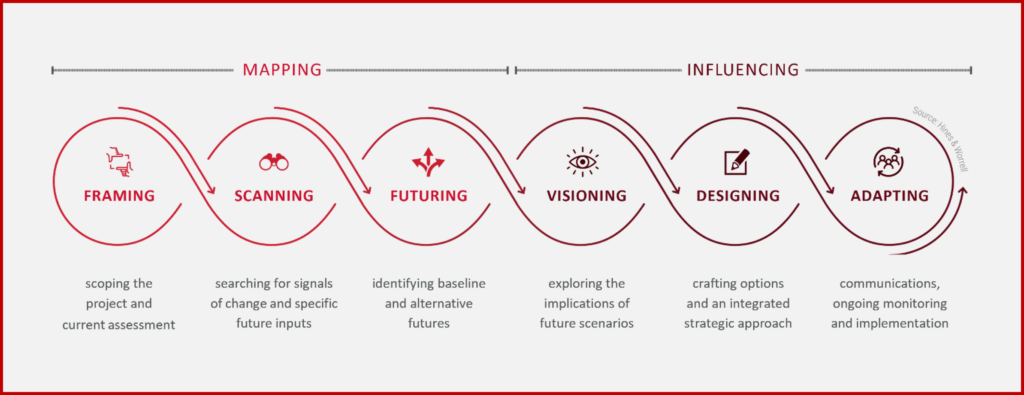
The Six Steps of Foresight were developed to provide as a practical framework to carry out foresight projects that could also be readily taught to students. But the Six Steps can be used in other ways as well. The applications are arranged below from “lighter” to “heavier” use:
- Keynotes: For those new to foresight, the Six Steps provide a basic flow to help them imagine how a foresight project works. A 30-, 60-, or 90-minute keynote presentation can be organized using the Six Steps as the outline with examples relevant to the particular audience.
- Workshops: With more time one can design a workshop, drawing upon the steps. For many years, I have delivered one-day workshop for beginners that takes them through each of the six steps. It is designed to whet the appetite. While it is a hard day’s work, it is different from most people’s “day jobs” and they typically enjoy the day and want more..
- Training: More in-depth work over the course of multiple days typically involves those who will subsequently be doing the foresight project work or involved in it as extended team members or consumers.
- Teaching: For new practitioners, it is typically hard to know where to start. We want our students to be able to design a project from scratch. The Six Steps provide a basic framework to get one started.
- Project work: The Six Steps provide a basic starting point such that one doesn’t have to reinvent the wheel for each project.
Dig in and enjoy! – Andy Hines

Leave a Reply