 by
by 
We introduced STILE in a post a few months ago. Now the published version — Delivering Insights with STILE — is in ESOMAR, a global research site and community for insights professionals. We consciously chose an insights forum as we believe that delivering insights is a fundamental deliverable of foresight that we need to emphasize now more than ever in the context of AI mania.
The STILE framework resulted from our career-long obsession with how to make foresight relevant and useful to clients. One major theme within that is developing tools to monitor the future, so that clients actually ARE anticipating the future. We’re tired of the stories of how so-and-so and such-and-such missed the development of x, y, or z. In fairness to clients – and futurists I suppose – it is hard work to monitor and anticipate the future. As we have been trying to hammer home, change is slower than we think. Monitoring and anticipating is a long game that requires strategic thinking and patience. Yet, so often we hear of colleagues and their clients hungering for the quick fix, the latest tool, or as we say, the magic beans. It’s the wrong game for futurists. Of course, we do need to be aware of this context and not blindly urge clients to change. So, how we do balance what we know is a long game with clients who want to play a short game?
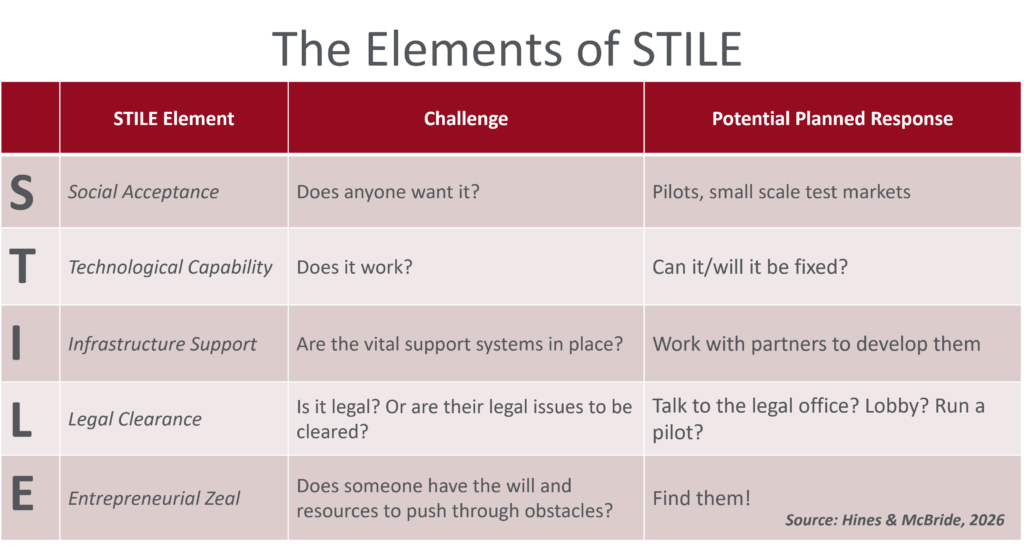
Enter STILE: Simple yet profound. Based on our research, we identified five key elements that need to be present for a change to successfully occur.
A key insight is that what is often “blocking” change is that one or more of the STILE elements is stalled. We believe all five need to be successfully in place for a change to successfully unfold. Nice and simple … right … five things to look for!
We’ve tested it with master’s students, certificate students and general audiences and it seems to connect really well. There is a beauty in its simplicity, as you’ll see in the piece itself. – Andy Hines

Leave a Reply