 by
by 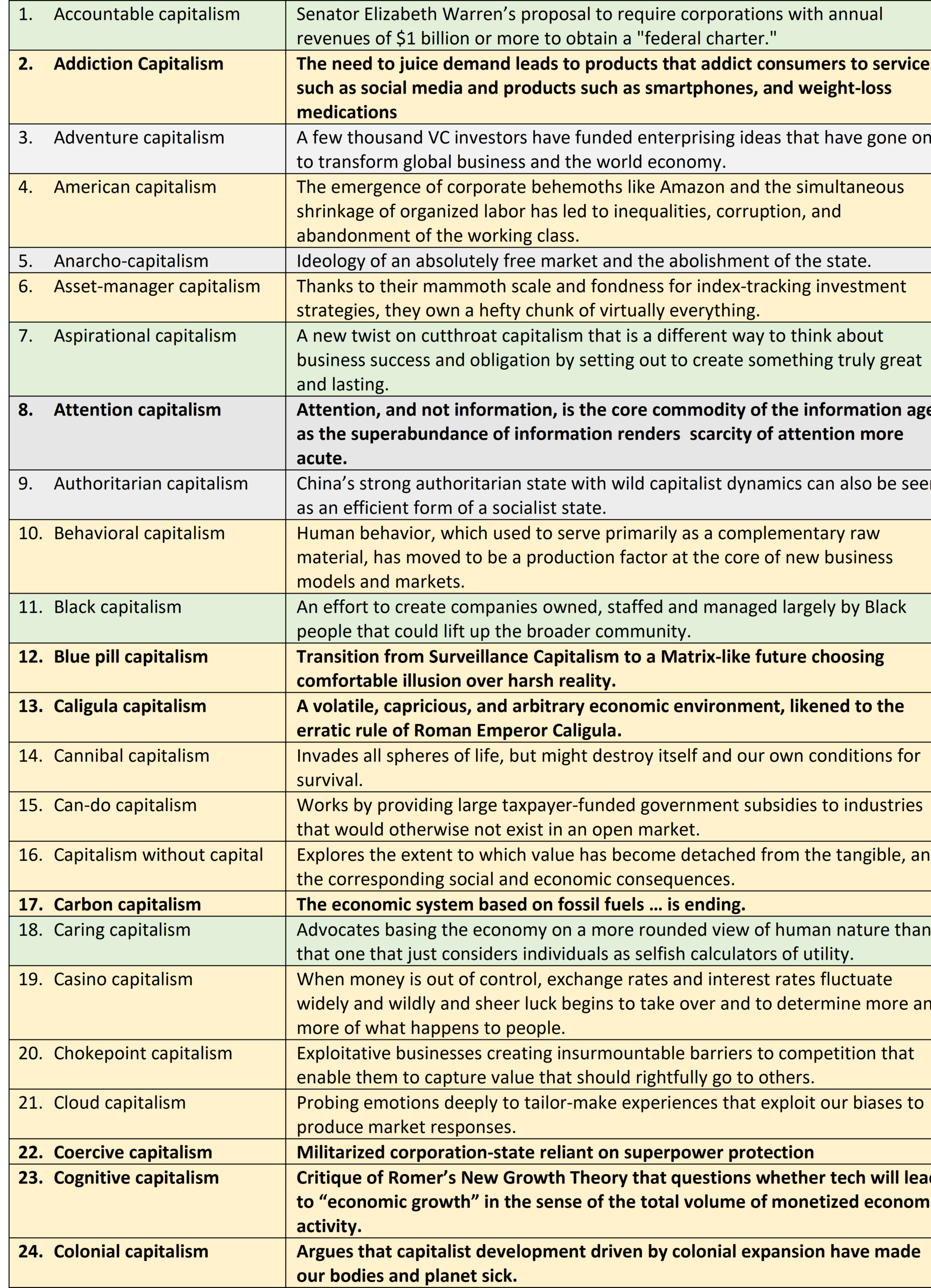
Do more alternatives emerge as a sign that something healthy or dying? Think y’all know where I stand, but you be the judge! My first alternatives list in 2021 had 38 varieties. The 2024 included in the Imagining After Capitalism book had 85. Today we are at … 113. Granted, these are not all thoroughly developed economic alternatives and some are rants and some are marketing slogans. Nonetheless, this proliferation suggests something is afoot. But what?
The 30 new (or updated) varieties are in bold. They are organized into three themes: (downloadable table)
- Advocacy (27 including 6 new): proposes a variation with a moral or “good” purpose to improve capitalism, typically expanding the benefits to a larger group of people
- Critical (67 including 18 new): points out a major flaw or flaws within capitalism
- Analytical ( 19 including 3 new): sticks closest to an economics classroom type discussion
| Advocacy Varieties | |
| Accountable capitalism | Senator Elizabeth Warren’s proposal to require corporations with annual revenues of $1 billion or more to obtain a “federal charter.” |
| Aspirational capitalism | A new twist on cutthroat capitalism that is a different way to think about business success and obligation by setting out to create something truly great and lasting. |
| Black capitalism | An effort to create companies owned, staffed and managed largely by Black people that could lift up the broader community. |
| Caring capitalism | Advocates basing the economy on a more rounded view of human nature than that one that just considers individuals as selfish calculators of utility. |
| Common good capitalism | The method of achieving certain moral goods is the animating question. |
| Common sense capitalism | Seeks a path between identitarianism and communitarianism by offering a confident civic identity with market-based solutions. |
| Community capitalism | Company(s) inviting local community members to become shareholders |
| Compassionate capitalism | Advocates for a contradictory machinery to run underneath the current global capitalism so that there could be some mitigating factors over the consequences for people in the world. |
| Connected capitalism | When companies connect the bottom line of their businesses with a social conscience. |
| Conscious capitalism | Believes consumers will do good if given the opportunity, |
| Co-op capitalism | A new way forward that reconnects the economy with society and puts collaboration, community and the collective first. |
| Cuddly capitalism | Nations (e.g., Nordic) that provide an economic equity that makes a middle class lifestyle the norm and social services are taken care of. |
| Global capitalism | Suggests real transformation can only happen if those in the global north join forces with migrants and exploited workers in the global south. |
| Human capitalism | Japan’s cohesive society has allowed it to maintain collective values that have promoted greater equity. |
| Humanistic capitalism | Integrates the strengths of capitalism with a deep commitment to human values and social justice that prioritizes the welfare of all individuals. |
| Inclusive capitalism | Investment that delivers positive economic and positive social outcomes is the best way to achieve progress at scale by enabling more people to benefit. |
| Network capitalism | Emphasizes multi-stakeholder networks, and the ability to engage in meaningful stakeholder partnerships. |
| Participatory capitalism | A system where power and economic rewards are distributed between participants. |
| Patriotic capitalism | Notion of putting the best interests of the country at the top of the pecking order. |
| Public interest capitalism | Possibilities of a more ethically grounded economic model. |
| Regenerative capitalism | Looks beyond net-zero emissions and setting eyes on leaving a net-positive impact on the planet. |
| Responsible capitalism | Operates at the intersection of commercial, social and sustainable development. |
| Satoyama capitalism | Japanese concept that fills the gap of truly money-centered capitalism by putting more weight on the value of cashless exchange, including self-sufficiency, bartering and gifting, |
| Stakeholder capitalism | The idea that businesses have a responsibility that extends beyond their shareholders. |
| Sustainable capitalism | Integrates sustainability into the traditional capitalist model to maximize profits while minimizing negative environmental and social impacts. |
| Techno-capitalism | System that rewards wealth creation while seeking equitable access to its benefits. |
| Values-based capitalism | Advocates changing the dynamics of politics, towards a system where businesses are active participants in shaping a better society. |
| Critical Varieties | |
| Addiction Capitalism | The need to juice demand leads to products that addict consumers to services such as social media and products such as smartphones, and weight-loss medications |
| American capitalism | The emergence of corporate behemoths like Amazon and the simultaneous shrinkage of organized labor has led to inequalities, corruption, and abandonment of the working class. |
| Asset-manager capitalism | Thanks to their mammoth scale and fondness for index-tracking investment strategies, they own a hefty chunk of virtually everything. |
| Behavioral capitalism | Human behavior, which used to serve primarily as a complementary raw material, has moved to be a production factor at the core of new business models and markets. |
| Blue pill capitalism | Transition from Surveillance Capitalism to a Matrix-like future choosing comfortable illusion over harsh reality. |
| Caligula capitalism | A volatile, capricious, and arbitrary economic environment, likened to the erratic rule of Roman Emperor Caligula. |
| Cannibal capitalism | Invades all spheres of life, but might destroy itself and our own conditions for survival. |
| Can-do capitalism | Works by providing large taxpayer-funded government subsidies to industries that would otherwise not exist in an open market. |
| Capitalism without capital | Explores the extent to which value has become detached from the tangible, and the corresponding social and economic consequences. |
| Carbon capitalism | The economic system based on fossil fuels … is ending. |
| Casino capitalism | When money is out of control, exchange rates and interest rates fluctuate widely and wildly and sheer luck begins to take over and to determine more and more of what happens to people. |
| Chokepoint capitalism | Exploitative businesses creating insurmountable barriers to competition that enable them to capture value that should rightfully go to others. |
| Cloud capitalism | Probing emotions deeply to tailor-make experiences that exploit our biases to produce market responses. |
| Coercive capitalism | Militarized corporation-state reliant on superpower protection |
| Cognitive capitalism | Critique of Romer’s New Growth Theory that questions whether tech will lead to “economic growth” in the sense of the total volume of monetized economic activity. |
| Colonial capitalism | Argues that capitalist development driven by colonial expansion have made our bodies and planet sick. |
| Communicative capitalism | How digital communication technologies—like social media, blogs, and comment threads—absorb and neutralize political dissent under capitalism |
| Consumer capitalism | Consumer demand is manipulated in a deliberate and coordinated way on a very large scale through mass-marketing techniques. |
| Control capitalism | Increase in private ownership, in which owners control the enterprise and only answer to themselves, compared to public company’s owner/leaders beholden to investors. |
| Corporate capitalism | Disregard for the needs of workers, families, and communities; along with its contempt for regulatory and ecological boundaries. |
| Counterfeit capitalism | Businesses that compete solely on access to capital, which they use to create products that are worth less than the sum of their parts. |
| Crack-up capitalism | Holds that the world economy is a lot more fragmented and disunited than is realized, with many political actors keen on actually accelerating it. |
| Crony capitalism | Businesses thrive not as a result of risk, but rather as a return on money amassed through a nexus between business and politics. |
| Data capitalism | Aka surveillance capitalism, it is the unrestricted use of private human experience as a source of free data on human behavior and is used as a source of profit. |
| Deals-based capitalism | Argues against a shift a rules-based approach with consistent standards over a striking case-by-case deals with regulators |
| Destitution capitalism | The state should not regulate economic activity for the greater good but is ever more intrusive in its surveillance of the lives. |
| Disaster capitalism | Politicians and the private sector exploit disaster to grow richer from it. |
| Emotional capitalism | Dual process by which emotional and economic relationships come to define and shape each other. |
| End-stage capitalism | Suggests the need to begin asking if civilization is going to survive capitalism in this form. |
| Extinction capitalism | Growth is driving the destruction of species and the planet’s life-support systems. |
| Extractive capitalism | A small elite securing an excessive slice of the economic pie. |
| Extreme capitalism | The rich raise too much money and leave too little for the rest of society leading to a decline in consumption and stagnation. |
| Fake capitalism | The result when government policies channel economic activity into small numbers of large, powerful companies. |
| Financial capitalism | Economic surplus is claimed by passively extracting interest or economic rents broadly rather than contributing to production. |
| Gangster capitalism | Derived from a true crime podcast that is focused on the dark side of the American dream. |
| Gotcha capitalism | Exposes how hidden fees and deceptive practices by companies take advantage of consumers |
| Green capitalism | Market-based approaches to solving the climate crisis that has come under attack from some environmentalists for greenwashing. |
| Intellectual monopoly capitalism | Knowledge, which should be a (non-rival, non-exclusive) public good, has been privately appropriated by top companies as capital. |
| Internalized capitalism | Idea that our self-worth is directly linked to our productivity. |
| Late capitalism | A catchall phrase for the indignities and absurdities of our contemporary economy, with its inequality and super-powered corporations and shrinking middle class. |
| Low-road capitalism | Wages are depressed as businesses compete over the price, not the quality, of goods; so-called unskilled workers are typically incentivized through punishments, not promotions; and inequality reigns and poverty spreads. |
| Mercenary capitalism | Prioritizing corporate monetary gain over social concerns or long-term stability. |
| Miracle capitalism | Cyclical anointing of the latest variation of capitalism as a savior , with technology as the current savior. |
| Modern capitalism | Skeptics say too many businesses extract value from the economy rather than add it by using monopoly power, or favorable treatment from conflicted or ideologically friendly regulators. |
| Money-centered capitalism | Critics say more weight should be placed on the value of cashless exchange, including self-sufficiency, barter, and gifting, |
| Monocapitalism | Aka financial capitalism, which focuses strictly on the financial aspect and decapitalizes the entire system. |
| Naked capitalism | Capitalism’s tattered and moth-eaten clothes have fallen off, revealing a naked body that serves only the privileged few. |
| Nationalist capitalism | A new recipe in which a large sector of private enterprises co-exists with a large sector of state-owned enterprises. |
| Political capitalism | Critique of approach where the cheapest, most reliable way to improve your rate of profit is to invest in the political process, to get favorable regulation, pork barrel government contracts, and cash bailouts. |
| Post-Covid capitalism | Regression playing out in India with the contraction of the economy, massive job losses and ruinous medical expenditures. |
| Predatory capitalism | Characterized by businesses that prey on each other, people, and the environment and that destroy or absorb their competition. |
| Psychedelic capitalism | People making money off medicines that, in the case of some psychedelics at least, have existed for millennia. |
| Racial capitalism | Process of deriving value from the racial identity of others, harms the individuals affected and society as a whole. |
| Rainbow capitalism | Economic involvement in the appropriating and profiting from the LGBT movement. |
| Ransom capitalism | The process of capital (e.g., IMF, World Bank and multinational corporations) holding the public for ransom during financial, energy and even public health crises |
| Rentier capitalism | Having and owning – thereby controlling access – is enormously more profitable than making or serving. |
| Savage capitalism | Capitalism is at a decision point where it will be decided whether the human experiment on Earth will continue in any recognizable form. |
| Scaredy-cat capitalism | American business is acting slowly and timidly, waiting for the uncertainties to shake out and trying not to call much attention to itself. |
| Shakedown capitalism | Critique in which pay-to-play appears to be the new norm, and every interaction is a chance to score some extra cash. |
| Spiderweb capitalism | The shadowy, international web of political and economic elites and the secretive and corrupt practices they use to make and protect their money. |
| Stick-holder capitalism | Companies at the permanent, tempering risk of punishment, inconsistency, coercion and sudden, top-down rewriting of concepts or rules. |
| Surveillance capitalism | Unilaterally claims human experience as free raw material for translation into behavioral data for economic use. |
| Termite capitalism | Critique of private equity model of takeover and ownership as akin to inviting termites into one’s house. |
| Twenty-first century capitalism | Capitalists are not by and large reinvesting their profits to develop new capacities to expand output or increase labor productivity. |
| Vulture capitalism | Nurtured in US, focuses wholly on corporate survival and success for shareholders at the expense of workers, managers, communities, and country. |
| White capitalism | Black activist term for the economic system and the racial structures that are connected with policing that literally kills black people. |
| Woke capitalism | A form of marketing, advertising and corporate structures related to sociopolitical standpoints tied to social justice and activist causes. |
| Analytical Varieties | |
| Adventure capitalism | A few thousand VC investors have funded enterprising ideas that have gone on to transform global business and the world economy. |
| Anarcho-capitalism | Ideology of an absolutely free market and the abolishment of the state. |
| Attention capitalism | Attention, and not information, is the core commodity of the information age, as the superabundance of information renders scarcity of attention more acute. |
| Authoritarian capitalism | China’s strong authoritarian state with wild capitalist dynamics can also be seen as an efficient form of a socialist state. |
| Conglomerate capitalism | Industrial consolidation has proceeded apace with many sectors being taken over by fewer and bigger entities. |
| Contra capitalism | Practices that go counter to or against capitalism. |
| Distributed capitalism | Decentralized systems that aim to create permissionless usage by avoiding centralized gatekeepers. |
| Free-market capitalism | The laws of supply and demand, rather than a central government, regulates production, labor, and the marketplace. |
| Gonzo capitalism | Explores outside-the-box methods for earning money. |
| Industrial capitalism | Capitalism based on production of goods in contrast to financial capitalism based on finance. |
| Intangible capitalism | Corporate returns, productivity, and economic growth will increasingly be tied to a dematerialized, digitized, knowledge-driven world. |
| Laissez-faire capitalism | Full, pure, uncontrolled, unregulated laissez-faire capitalism with a separation of state and economics. |
| Multicapitalism | Proposes a move to a system value view where six different types of capital are created and maintained within systemic interconnections. |
| Neoliberal capitalism | The current capitalist Baseline, which is defined by privatization, deregulation, free trade, commodification of public goods, and managed by international institutions, and using other decentralized institutions like NGOs and think thanks to influence public opinion. |
| New capitalism | Japan’s program of driving growth via an economic strategy focused on investment in human resources, science and technology, innovation, and start-ups, as well as green and digital transformation. |
| Perfect capitalism | Michio Kaku’s concept that the wealth of society comes from physics and will eventually produce infinite knowledge of supply and demand. |
| Platform capitalism | A system where power and economic rewards are distributed between networked participants. |
| Space capitalism | Privatization and commercialization of space. |
| State capitalism | Originally conceived as a transitional stage en route to a socialism different from and beyond state capitalism that has come to define socialism. |
The majority of the varieties, and continuing to game stream, are critical [yellow] at 60%. Next were the advocacy proposals [green] at 24%, and finally the analytical varieties [gray] 16%. In short, the large and growing chorus of complaints about capitalism continues. There is a smaller set of ideas on what to do about it, and fewer yet serious proposals. This absolutely fits with my sense of the state of play today.
Care to share your favorite? I think mine is scaredy-cat capitalism … kind of a unique blend that hits the nail on the head. – Andy Hines

Leave a Reply