An updated second edition is available on Amazon for $14.95 paperback and $6.99 e-book. The changes include:
- Most important, our additional work on the process of using the six framework activities opened up an opportunity to provide specific “how-to” process advice to supplement the guidelines. Thus, I added a new step-by-step how-to chapter to conclude the book.
- Some of the guideline examples were getting a bit dated. All the examples of the 115 guidelines were reviewed and 55 were updated. This also add some new references.
- My friend and colleague John Smart, who inspired several folks to review the book and thus helped deplete the first edition, was adamant that I change the shape of the new edition paperback, so it is now a 6×9 instead of the original square. The cover is redesigned as well.
An essential reference guide to help executives, analysts, and educators prepare for the future
This highly scannable book provides examples, benefits, and key steps that will help leaders securely position their organizations for years to come
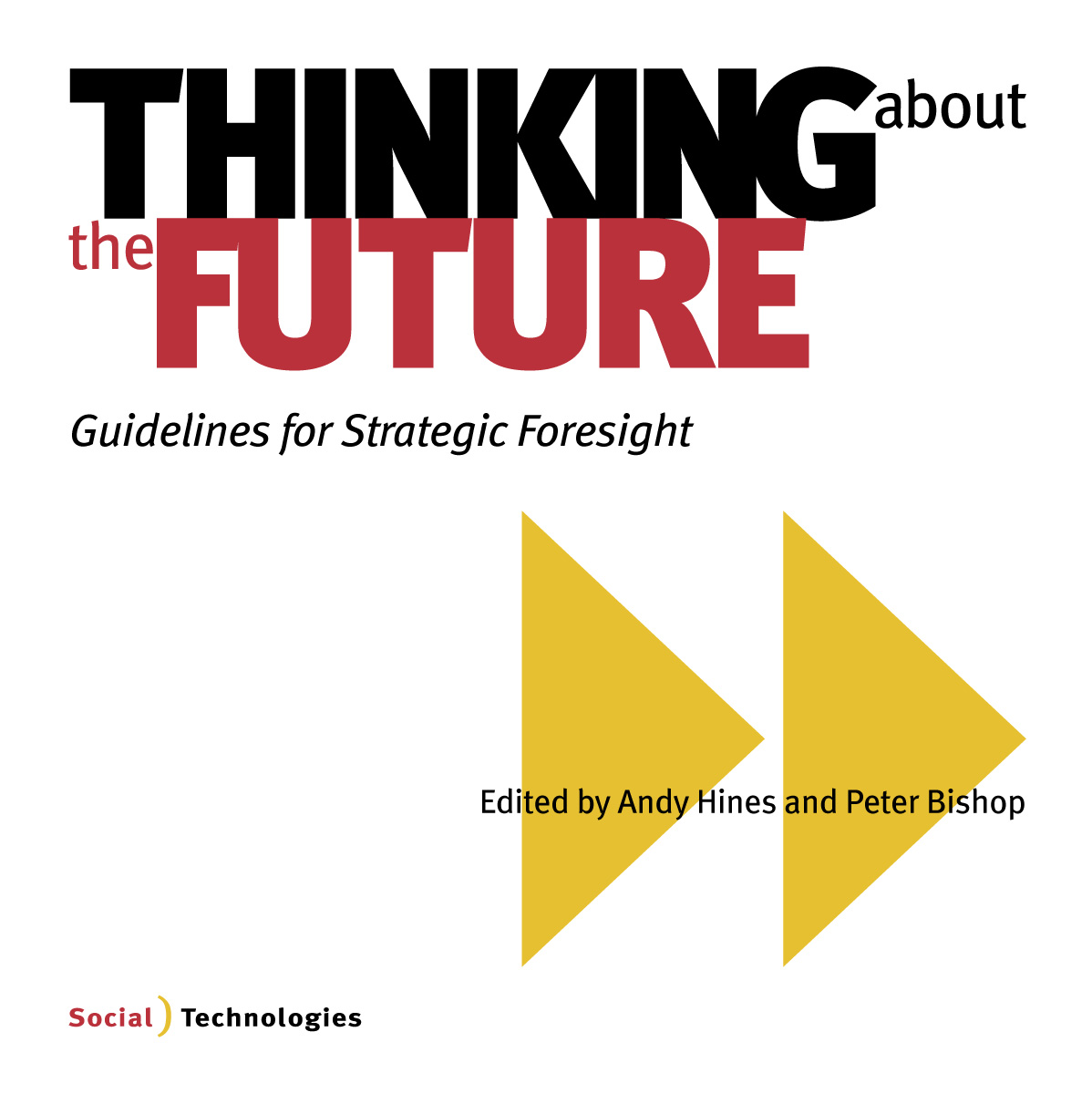
“There has perhaps never been a time in human history when strategic foresight is more needed,” says futurist Andy Hines in the introduction to his new book, Thinking about the Future: Guidelines for Strategic Foresight (Social Technologies, February 2007).
Precious little guidance is available for executives, analysts, and educators seeking the best way to plan and prepare for the future. That is why Hines and Peter Bishop put together the 231-page paperback, which distills the expertise of 36 world-renowned futurists into an easily scannable guidebook.
Back to the future: What is strategic foresight?
Because the future is not predetermined or predictable, future outcomes can be influenced by our choices in the present, Hines and Bishop explain—and that is where strategic foresight comes into play.
At once highly creative and methodical, strategic foresight gives organizations the ability to create and maintain a high-quality forward view to detect threats and opportunities before they reach mainstream awareness, to guide policy, and to shape strategy. The ultimate goal of strategic foresight is to make better, more informed decisions in the present—making it the ideal tool for exploring new markets, products, and services, or more generally for successfully navigating the rapids of today’s constantly shifting, increasingly complex global environment.
“Although this is a highly logical approach to planning for the future, we don’t expect leaders and managers of companies to know how to do it without any training,” says Hines. “In fact, the reason we wrote the book was to provide essential, need-to-know information that can immediately be put into practice. Whether it is for corporate strategy, government policy, community development, or to better understand customers and markets, I firmly believe organizations that follow these guidelines will be more effective than those that do not.”
How to navigate the guide
The book is packed with case studies, practical tips, and 115 guidelines—yet is highly scannable because Hines and Bishop break the information down into easy to understand categories that mirror the six phases of strategic foresight:
- Framing: This important first step enables organizations to define the scope and focus of problems requiring strategic foresight. By taking time at the outset of a project, the team analyzing a problem can clarify the objective and determine how best to address it.
- Scanning: Once the team is clear about the boundaries and scope of an activity, it can scan the internal and external environments for relevant information and trends.
- Forecasting: Most organizations, if not challenged, tend to believe the future is going to be pretty much like the past. When the team probes the organization’s view of the future, they usually find an array of unexamined assumptions that tend to converge around incremental changes. The task, then, is to challenge this view and prod the organization to think seriously about the possibility that things may not continue as they have—and in fact, rarely do. Considering a range of potential futures is the only surefire way to develop robust strategies that will position the organization securely for any future that may occur.
- Visioning: After forecasting has laid out a range of potential futures, visioning comes into play—generating the organization’s ideal or “preferred” future and starting to suggest stretch goals for moving toward it.
- Planning: This is the bridge between the vision and the action. Here, the team translates what could be into strategies and tactics that will lead toward the preferred future.
- Acting: This final phase is largely about communicating results, developing action agendas, and institutionalizing strategic thinking and intelligence systems, so the organization can nimbly and continually respond to the changing external environment.
How executives and analysts can use this book
Executives will find both the guidelines and framework of the book to be invaluable when it comes to understanding what it takes to successfully explore the future. Specifically, the book will help leaders:
- Design strategic foresight projects
- Develop robust strategies that can stand up to a wide array of possible futures
- Find how-to answers to specific tasks
- Provide a refresher for experienced practitioners
- Adopt guidelines for excellence as an organization
How educators can use the book
Practicing and critiquing the guidelines in a classroom setting will provide a valuable learning experience for undergraduate and graduate students studying political science, economics, policy analysis, education, and more. Specifically, students will:
- Examine important tenets of futurist theory and research
- Understand how futurist thinking can powerfully strengthen an organization’s strategic thinking and acting on a day-to-day basis
- Obtain a strong intellectual edge in preparing for careers in management or consulting
- Role play and interview analysts
- Corroborate or modify their own assumptions
“Although this book is for those seeking guidance on the strategic forefront, it is not intended to ‘convert’ anyone into becoming a foresight professional,” Hines concludes. “On the other hand, the lure of long-term change can be compelling. Many who get bitten by the foresight bug want to learn more.”
Availability
Single copies on Amazon @$14.99: Thinking about the Future
Bulk copies discounted: Please email Andy Hines, ahines@uh.edu